
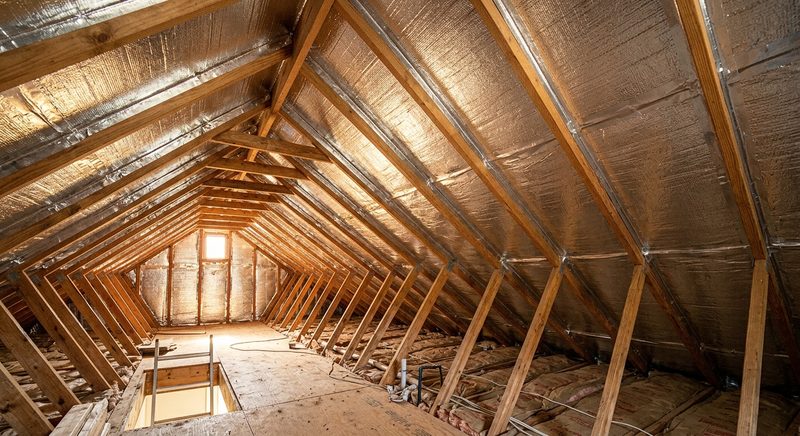
Radiant Barrier with Solar Panels: Does It Help in DFW?
Learn how a radiant barrier with solar panels reduces cooling load and system size in DFW. Lower attic temps by 25-40°F and cut solar costs.
Does Radiant Barrier Help If You Have Solar Panels?
Short answer: yes. I'm Neal. I've spent 20 years in DFW attics, and this question comes up more than you'd think. Homeowners assume solar panels alone cover their energy needs. They don't account for the heat load sitting right above their ceiling. A radiant barrier reflects up to 97% of radiant heat back out of your attic. That means your air conditioner works less. And if your AC works less, you need fewer panels. The National Renewable Energy Lab (NREL) and Sunflowers Energy found bundling roof, insulation, and solar upgrades can deliver 40% or more in energy savings. For DFW homeowners, that's not a theory. It's a fact.
The IECC 2021 recognizes radiant barriers as part of the compliance path for Climate Zone 3 under Section R402. Current code calls for R-38 minimum attic insulation (U-factor 0.030) in Climate Zone 3 for new construction; most DFW retrofit homes are below that. Radiant barriers work alongside this insulation to reduce radiant heat gain, which is particularly effective in Zone 3B (mixed-dry) climates like DFW.
How Radiant Barrier Lowers Your Cooling Load
DFW has over 3,000 cooling degree days a year. That's a lot of heat your AC has to fight. A radiant barrier reduces attic temperatures by 25 to 40 degrees Fahrenheit. Those numbers come from Oak Ridge National Laboratory's radiant barrier research. When your attic is cooler, your ductwork doesn't pick up as much heat. Your AC doesn't run as long. The result is a direct reduction in your cooling load. For a typical 2,000-square-foot home in DFW, that means summer AC bills drop from $200-400 per month toward the lower end. HomeAdvisor reports radiant barrier installation averages $0.50 to $2 per square foot, while Angi shows DFW homeowners typically pay $1,200 to $2,500 for professional installation. You also extend the life of your HVAC system. It's mechanical. Less runtime means less wear.
Smaller Solar System Size with Radiant Barrier
A 100% solar offset on a 2,000-square-foot DFW home usually requires an 8-kilowatt system. That's about 20 panels. But when you add a radiant barrier, the math changes. With a 5-10% reduction in cooling load, the system-size benefit is modest: plan on a slightly smaller array rather than a dramatically cheaper one. A radiant barrier is not what makes solar pencil out. You may also qualify for the Oncor solar program; the federal 30% residential clean energy credit covers the solar panels themselves, but radiant barrier foil does not qualify, so do not count a credit on it. The combination pays for itself faster than either upgrade alone.
Attic Insulation Matters Too
A radiant barrier stops radiant heat. But it doesn't stop conductive heat transfer through your insulation. That's where your existing attic insulation comes in. If you have R-19 or less, you're losing conditioned air and letting heat in. For DFW, I recommend R-38 to R-60 in the attic floor. Pair that with a radiant barrier on the underside of your roof deck. Reflecting the radiant load at the deck and slowing conduction at the ceiling is the combination that works in a hot climate. If your insulation is old, compressed, or rodent-damaged, replace it first. Then add the radiant barrier. The order matters.
When You Should Not Add a Radiant Barrier
Most contractors won't tell you this. I will. Do not install a radiant barrier if your attic has active moisture problems or roof leaks. A radiant barrier reflects heat. It does not fix water damage. Seal the roof first. Also skip it if your insulation is already doing the job and your attic is cool to the touch on a 100-degree day. That's rare in DFW, but it happens. Finally, if you're not planning to stay in the house for at least five years, the payback period on a radiant barrier plus solar might not pencil out. In that case, focus on simple air sealing and insulation instead. I'd rather lose a sale than sell you something that doesn't work for your situation.
How to Combine Radiant Barrier and Solar in DFW
Start with an attic inspection. I look at insulation depth, air leaks, duct condition, and roof deck temperature. If the attic hits 130 degrees on a summer afternoon, a radiant barrier will help. Next, get quotes for both the radiant barrier and solar from separate specialists. Some solar companies include radiant barrier in their installs. Most don't. Ask specifically. The ENERGY STAR Seal and Insulate page covers the insulation-and-air-sealing half of the job. Install the radiant barrier first, then solar. That way your solar system is sized based on your actual reduced load, not the pre-existing heat soak. The federal clean energy credit applies to the solar panels, not the radiant barrier — so plan the barrier as an efficiency upgrade, not a tax credit.
My Final Take on Radiant Barrier with Solar
Your search query was about whether radiant barrier helps with solar panels. It does. It reduces your cooling load by a measurable amount. That means you buy fewer panels. That means you save money upfront and every month after. In DFW, where summer AC bills can hit $400, the combination is practical, not theoretical. I don't sell solar panels. I only do attic insulation and radiant barriers. But I've seen enough houses in North Texas to know this works. If you're considering solar, call a radiant barrier installer first. Get the attic right. Then let the solar company size your system. You'll thank yourself when July comes.
Frequently Asked Questions
Does a radiant barrier reduce the number of solar panels I need?
Will a radiant barrier work with my existing solar panels?
How much does a radiant barrier cost in DFW?
Does a radiant barrier damage roof shingles?
Should I replace attic insulation before adding a radiant barrier?
Can I install a radiant barrier myself?
Thinking about adding solar and a radiant barrier? Call me at (469) 895-2695 for an attic inspection. I'll tell you if the combination makes sense for your home in DFW.
Get a free estimate
Fill out the form and we'll get back to you within 24 hours. No pressure, no upsells.
Neal runs DFW Attic Insulation, a local crew serving the entire Dallas-Fort Worth metroplex. He started in roofing and construction over two decades ago and now specializes in attic insulation, air sealing, and ventilation. He believes in honest advice — he'll tell you if you don't need anything.