
Spray Foam vs Blown-In Insulation for DFW Home Additions
Choosing between spray foam and blown-in insulation for your DFW home addition? I explain which works best for attics and walls based on Texas energy code and real attic conditions.
Start With Code, Then Choose
If you're building a home addition in DFW, the city will require R-38 attic insulation and R-20 walls. That's the current standard under the 2021 International Building Code adopted in Texas. You cannot ignore this. An inspection will fail if the insulation doesn't meet those minimums. I see homeowners choose the wrong material for their addition because they don't start with code. Here's the truth: both spray foam and blown-in insulation can meet R-38. But they do it very differently. Spray foam gives higher R-value per inch — R-6 to R-7. Blown-in fiberglass or cellulose gives about R-2.5 to R-3.5 per inch. That means your attic depth changes based on your choice. For a home addition, the framing limits your cavity depth. I check that first before recommending one.
The IECC 2021 Table R402.1.2 sets the prescriptive minimum for attic insulation in Climate Zone 3 (which includes DFW) at R-38, with an equivalent U-factor of U-0.030. The International Residential Code (IRC) Section R806 requires balanced attic ventilation at a 1:300 ratio minimum.
Spray Foam in a Home Addition: When It Works
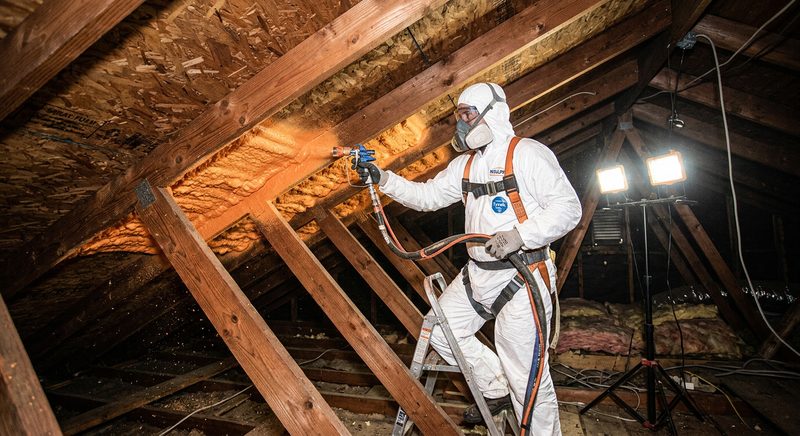
Spray polyurethane foam is the best choice for new construction or additions where the framing is exposed. The Department of Energy points out that spray foam seals air leaks while insulating. In a home addition, you have control over the framing. You can spec 2x6 or 2x8 walls. That lets you use closed-cell foam at R-6 to R-7 per inch. I recommend spray foam for additions that have complicated roofs — dormers, skylights, cathedral ceilings. Those areas are hard to insulate with blown-in material. The foam fills every gap. It also adds structural rigidity. Here's a fact: closed-cell foam has a vapor barrier built in. For DFW's humid climate, that cuts the risk of moisture in wall cavities. But spray foam costs more. Expect to pay 30 to 50 percent more than blown-in. Only use it if your addition has complex geometry or you're building a conditioned attic.
Blown-In Insulation in a Home Addition: When It Works
Blown-in fiberglass or cellulose is the standard for attic floors and simple wall cavities. For a ranch-style addition with a truss roof, blown-in is the most cost-effective way to hit R-38. I install it in attics that have standard 2x4 or 2x6 trusses with a flat ceiling. The material settles over time, so I always overfill by 10 percent. Blown-in cellulose has a higher recycled content — 80 percent post-consumer waste — and uses borates for fire resistance and pest control. Energy Star confirms that blown-in insulation works well in attics with obstructions like wiring and ductwork. For a home addition where the attic is hard to access, I prefer blown-in because it reaches every nook. But it does not seal air leaks. You must air-seal the attic floor before installing blown-in. Skip that step and your R-38 performs like R-19. I see that mistake often.
DFW Humidity and Moisture: The Deciding Factor
North Texas has hot summers and high humidity through September. That moisture migrates into attics. Spray foam creates a sealed, conditioned attic space. That stops humid outdoor air from hitting cold ductwork. I recommend spray foam for additions that have HVAC equipment in the attic. A sealed attic keeps ducts at 75 degrees instead of 130. Building America conducted research showing that unvented attics with spray foam outperform vented attics with blown-in insulation in hot-humid climates. But blown-in in a vented attic works fine if the attic has proper intake and exhaust vents. I measure the net free vent area before installing blown-in. If the addition's roof has low pitch or no ridge vent, I push for spray foam to avoid moisture condensation in winter. You do not want mold in a new addition. I've seen it.
Cost and Labor: What You Pay For
Spray foam runs $1. HomeAdvisor reports whole-home renovation costs average $15,000 to $60,000, with attic insulation representing $1,700 to $2,500 of that budget according to Angi.50 to $3.00 per board foot installed. For a 500-square-foot addition with a cathedral ceiling, expect $4,500 to $6,000. Blown-in insulation runs $0.80 to $1.50 per square foot for R-38. That same addition costs $800 to $1,500. The labor is different too. I spray foam in one day — two if the addition is large. Blown-in takes half a day. But the long-term savings from spray foam can offset the upfront cost. The Department of Energy states that air sealing saves 15 to 25 percent on heating and cooling. Spray foam seals while insulating. Blown-in does not seal. If you plan to stay in the home for more than 10 years, spray foam pays back faster. If you're selling in 5 years, blown-in is the smarter financial move. I tell clients not to overspend if they aren't staying long.
When Not to Buy Spray Foam
Do not use spray foam if your addition has old wiring. The foam hardens around wires and makes future repairs impossible. I've had clients who could not replace a light fixture because the junction box was buried in foam. Also avoid spray foam if the roof deck has existing leaks. The foam traps moisture against the sheathing and causes rot. Do not use spray foam in a vented attic design. You create a thermal sandwich that fails. For blown-in, do not use it in cathedral ceilings with limited depth. You need 12 to 14 inches for R-38. If the rafter is only 8 inches deep, you cannot get R-38 with blown-in. Use spray foam or rigid foam instead. I turn down jobs when the math doesn't work. Not every addition needs the premium option.
Code Compliance and Permits for DFW Additions
Every home addition in DFW requires a permit and inspection. The city checks insulation against the Texas amendments to the 2021 IBC. The attic must have R-38. Wall cavities must have R-20. I provide documentation of the installed R-value and material type. Spray foam requires a flame spread rating below 25 and smoke development below 450. I use closed-cell foam with a coating for exposed applications. Blown-in cellulose must be marked with the settled R-value. I test depth in five spots per 500 square feet. If the inspection fails, I fix it at no labor cost. I handle permits because they require mechanical plans and insulation specs. You don't want to fight City Hall over insulation. I make sure my installs pass the first time.
Frequently Asked Questions
Can I mix spray foam and blown-in insulation in the same home addition?
Is spray foam safe for a home addition with a toddler room?
How long does it take to insulate a 400-square-foot home addition?
Does blown-in insulation settle in a home addition?
Can I install insulation myself in my DFW home addition to save money?
Need help choosing the right insulation for your DFW home addition? Call me at (469) 895-2695 to talk through your addition's framing, budget, and timeline. If you want a straight answer on your attic, call me at (469) 895-2695. I'll inspect it with a thermal camera, tell you exactly what you need, and give you a written quote. No upsell. No pressure.
P.S. Every attic is different. The numbers above are ballpark estimates based on DFW averages. Call us at (469) 895-2695 and we'll come take a look with a thermal camera, give you a written quote, and tell you honestly if you even need anything. No upsell. No pressure.
Get a free estimate
Fill out the form and we'll get back to you within 24 hours. No pressure, no upsells.
Neal runs DFW Attic Insulation, a local crew serving the entire Dallas-Fort Worth metroplex. He started in roofing and construction over two decades ago and now specializes in attic insulation, air sealing, and ventilation. He believes in honest advice — he'll tell you if you don't need anything.