
Attic Spray Foam Installation: Open Cell vs Closed Cell in DFW
Attic spray foam installation in DFW: open cell or closed cell? Neal walks through what each does, what it costs, and how the job should actually go.
The Answer: Choose by R-Value Needs, Then by Moisture
Closed cell for thin spaces that need maximum R-value. Open cell for bigger areas where you want to air-seal cheaply. That's the attic spray foam installation decision in one line. If you're looking up attic spray foam insulation for the first time, start here instead of the spec sheets: most DFW attics do better with a simple rule — open cell on the attic floor, closed cell on the roof deck. The exceptions are where moisture or duct placement changes everything.
Let me give you the number first (this is the same target behind every attic spray foam insulation job in DFW). Closed-cell spray foam gives you R-6.0 to R-6.5 per inch. Open cell gives R-3.5 to R-4.0 per inch. To hit the R-38 minimum this climate zone needs, you'd spray about two inches of closed cell or roughly four inches of open cell. In a tall DFW attic, open cell is usually the cheaper way to get there.
What Open Cell Does in a DFW Attic
Open cell is light, expands like shaving cream, and lets moisture pass through it. That last part matters more than most people expect. In our humid Texas climate, an attic needs to breathe. Open cell lets trapped vapor escape instead of turning into mold behind a solid barrier. On an attic floor, open cell at R-3.5 to R-4.0 per inch gives you a solid air-sealing insulation for less money than closed cell.
What Closed Cell Does in a DFW Attic
Closed cell is dense, rigid, and seals like a drum. It adds R-6.0 to R-6.5 per inch, which means you need half the thickness. It also acts as a vapor barrier and adds a little structural rigidity. That makes it the right call for a roof deck, a cathedral ceiling, or a rim joist where you can't afford the space. But that same vapor barrier is exactly why closed cell is dangerous in a vented attic. Trap the moisture and you've built a mold factory.
The Installation: What Actually Happens
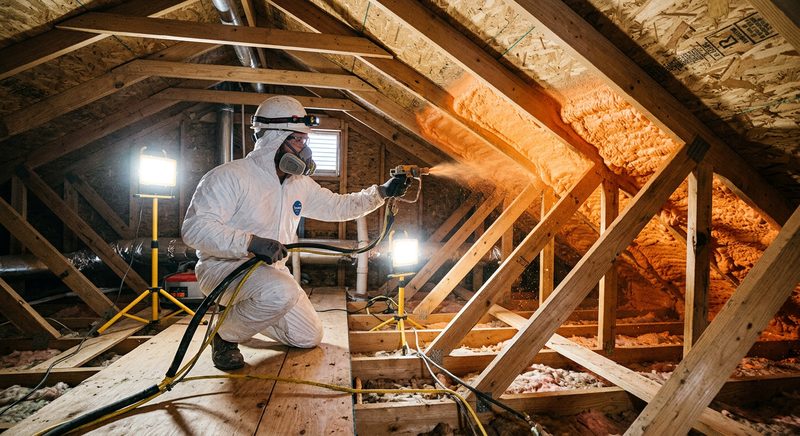
A proper attic spray foam installation starts before the first can touches anything. We inspect for active leaks, mold, and moisture. Those get fixed first. Then the crew protects your living space with plastic and tape — spray foam overspray is miserable to clean off a ceiling fan. The foam goes on in even passes at the right temperature. We finish by confirming coverage and curing. That post-install inspection is where cheap installers cut corners, and it's where moisture problems start.
What It Costs for a DFW Attic
Open-cell spray foam runs $1.50 to $2.20 per square foot installed. Closed cell runs $2.50 to $4.00 per square foot. For a typical 1,500-square-foot attic, that means roughly $2,300 to $3,300 for open cell to R-38, or $3,500 to $6,000 for closed cell. The closed cell buys you the air barrier and the vapor barrier in one shot, but you pay for it.
The Moisture Catch Nobody Wants to Learn the Hard Way
I've pulled closed-cell foam off vents and watched mold bloom behind it. Here's the rule I live by: if your attic is vented and you're not converting it to living space, don't spray closed cell on the floor. Use open cell, or use blown-in fiberglass and put your money into air sealing instead. If your attic is unvented and you're finishing it, closed cell on the roof deck is the right tool.
Spray Foam vs Blown-In for the Same Job
Here's the cost reality. Blown-in fiberglass reaches R-38 on that same 1,500-square-foot floor for about $1,300 to $2,200. Spray foam runs two to three times that. Spray foam's advantage is that it seals while it insulates. If your attic already lets air move through every crack, the foam's sealing value is real. If not, you're paying for something you didn't need.
When to Call a Contractor
DIY spray foam kits exist. They're fine for a small rim joist or a garage ceiling. They are not fine for a full attic. Spraying a whole attic by hand almost guarantees uneven thickness, overspray, and missed air gaps. That's where the moisture problems start. A crew with the right rig, the right surface prep, and a post-job inspection is worth the money. This is a job where the skill is invisible when it's done right and obvious when it's done wrong.
Where the R-38 Target Comes From
R-38 isn't a number I made up. The Department of Energy publishes climate-zone insulation levels, and DFW sits in zone 3 — which the ENERGY STAR program reads as R-38 minimum for attics, with R-49 recommended where it fits. I check those tables before every estimate, because "what's the target" is the first question that decides how much foam you need and what it costs. For a closed-cell system that means about two inches of roofline coverage; for open cell, closer to four inches of floor coverage.
The One Question Most Installers Hope You Don't Ask
Ask any contractor this before they start: "What's the dew point, and what's your plan if the temperature drops mid-spray?" A proper installation is temperature-sensitive — foam needs a certain surface temperature to cure flat and bond, and in a Texas attic in early summer or late fall that can change while the crew works. If a crew can't tell you how they handle that, they're spraying the same way in January as in July, and that's how you get uneven coverage that never really seals.
Frequently Asked Questions
Can I install spray foam in my attic myself?
How long does attic spray foam installation take?
What R-value do I need for an attic in DFW?
Is closed cell or open cell better for an attic?
Does spray foam eliminate the need for attic ventilation?
How much does attic spray foam cost in DFW?
Call me, Neal, at (469) 895-2695 to talk through the right spray foam choice for your DFW attic. I've seen what the wrong call does, and I'd rather you not learn that lesson the expensive way.
Get a free estimate
Fill out the form and we'll get back to you within 24 hours. No pressure, no upsells.
Neal runs DFW Attic Insulation, a local crew serving the entire Dallas-Fort Worth metroplex. He started in roofing and construction over two decades ago and now specializes in attic insulation, air sealing, and ventilation. He believes in honest advice — he'll tell you if you don't need anything.