Does a Radiant Barrier Work in DFW? The Honest Answer
Does a radiant barrier work in a DFW attic? Yes, under three conditions. Neal explains the air gap, perforated foil, and when it's a waste of money.
The Short Answer: Yes — With Three Conditions
Does a radiant barrier work in DFW? Yes, but only when three things are true, and I have walked into plenty of attics where none of them were. A radiant barrier reflects radiant heat off the underside of your roof deck instead of letting it radiate down onto your ceiling. In a metroplex where attic air hits 140–150°F on a July afternoon, that reflection is worth real money. The catch: it is not insulation, it does not replace insulation, and it only performs when it has an air gap and is left perforated so moisture can escape.
What a Radiant Barrier In practice Does
Insulation and radiant barrier solve two different problems, and homeowners conflate them constantly. Insulation slows conductive heat transfer. Heat moves through the ceiling assembly by contact, and R-value measures how well it resists that. Radiant barrier targets a different mechanism: radiant heat traveling in a straight line from a hot surface to a cooler one. Your roof deck absorbs sun all afternoon and radiates that energy downward into the attic. Foil with a low-emissivity surface reflects most of it back up at the deck instead of letting it pass.
That is why the two work together. Reflect the radiant load at the top, then slow whatever is left with R-38 or better at the ceiling. Neither one does the other's job.
What the Numbers Look Like in North Texas
I do not want to hand you a marketing number, so here is the honest range. The most-cited field study — Florida Solar Energy Center's monitoring of eight retrofitted central-Florida homes — measured 9% cooling savings and a 16% peak-load reduction. Oak Ridge National Laboratory's update is blunter: in climate zones 1–2 with poorly insulated, leaky attic ducts, expect $50–$150 a year; "for other conditions and locations, savings will be much smaller or negative." Attic temperature drops of up to 30°F are realistic on a clear summer day. Texas A&M's building science work lines up with that, and our own measurements in DFW attics land in the same neighborhood.
What that means for a typical DFW summer bill: if you are paying $250 a month to cool the house in July and August, a 5–10% cut is $13–$25 a month during the worst months. That is meaningful, but it is not a new car.
Where the savings get bigger is when a radiant barrier goes on an attic that is also under-insulated. The combination is where the 17%-ish combined figures come from. A radiant barrier on top of an R-8 attic is a bandage. A radiant barrier on top of R-38 is a genuine improvement.
Condition One: There Has to Be an Air Gap
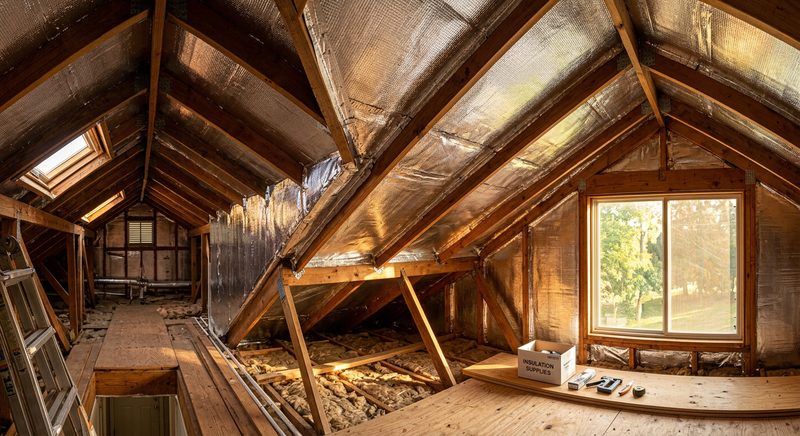
A radiant barrier only reflects when there is an air space between the foil and the hot surface. Foil stapled directly against the roof decking with no gap does much less. The install that works is foil run across the underside of the rafters, leaving a gap between the foil and the deck, with the foil facing down into the attic.
This is also why foil laid flat across the attic floor over your insulation is a mistake. It traps heat against the insulation, cuts off the airflow that keeps the assembly dry, and can trap moisture in the worst possible place. If someone sells you "foil on the floor," ask them to explain the air gap. They usually cannot.
Condition Two: Perforated, Not Solid
DFW humidity is the reason this matters. Solid foil is a vapor barrier. Put a vapor barrier on the underside of a roof deck in a humid climate and you have created a condensing surface. Water vapor migrating up from the house hits the foil, cools, and condenses. Over a few seasons that shows up as staining, sheathing damage, or worse.
Perforated foil has thousands of tiny holes that let vapor pass through while still reflecting radiant heat. Reflective performance barely changes; moisture problems largely go away. Any contractor quoting you solid foil on the deck in North Texas is telling you something about how they work.
Condition Three: It Has to Stay Clean
A radiant barrier's performance depends on a low-emissivity surface. Dust settles. In an attic with a leaky return duct or a lot of loose debris, the foil face dulls within a few years and performance drops. The attic does not have to be spotless, but it does have to be reasonably sealed. Fix the air leaks first, then install the foil.
When a Radiant Barrier Is a Waste of Money
I would rather talk you out of a job than sell you something that cannot pay back. Skip it if:
- Your attic already has R-38 or better insulation and the ductwork is sealed. The radiant load is not your bottleneck anymore.
- Someone proposes solid foil directly on the decking with no air gap. That is a moisture experiment, not an upgrade.
- The quote is for foil laid over the attic floor insulation.
- Your real problem is a leaking duct system or a 15-year-old AC unit. Fix that first. A radiant barrier will not rescue a failing system.
Where It Fits in a DFW Attic Plan
The order I recommend for most DFW homes, and the order that pays back fastest:
- Air seal the ceiling plane — top plates, can lights, bath fans, duct boots.
- Bring insulation up to R-38 or R-49.
- Seal and insulate the ducts in the attic.
- Add a perforated radiant barrier if the attic still runs hot.
Step four is genuinely optional in a well-insulated house. If you are re-roofing anyway, though, the marginal cost is low — the deck is already open, and foil on the deck is one of the cheapest upgrades you will ever get. That timing question is worth its own conversation.
Frequently Asked Questions
Does a radiant barrier lower cooling costs in DFW?
Is a radiant barrier a substitute for attic insulation?
Will a radiant barrier cause moisture problems in my attic?
Can I install a radiant barrier myself?
How much does a radiant barrier cost in DFW?
Related Reading
- Radiant barrier installation in DFW — what we install and how.
- DFW radiant barrier cost breakdown — per-square-foot pricing by type.
- Radiant barrier vs attic insulation — which one first, and why.
- Radiant barrier during roof replacement — the cheapest time to add one.
- Full DFW radiant barrier installation guide — the install, step by step.
- Oncor attic insulation rebate in DFW — what the utility will pay toward the insulation half.
Want a straight answer on your attic?
(469) 895-2695Get a free estimate
Fill out the form and we'll get back to you within 24 hours. No pressure, no upsells.
Neal runs DFW Attic Insulation, a local crew serving the entire Dallas-Fort Worth metroplex. He started in roofing and construction over two decades ago and now specializes in attic insulation, air sealing, and ventilation. He believes in honest advice — he'll tell you if you don't need anything.